
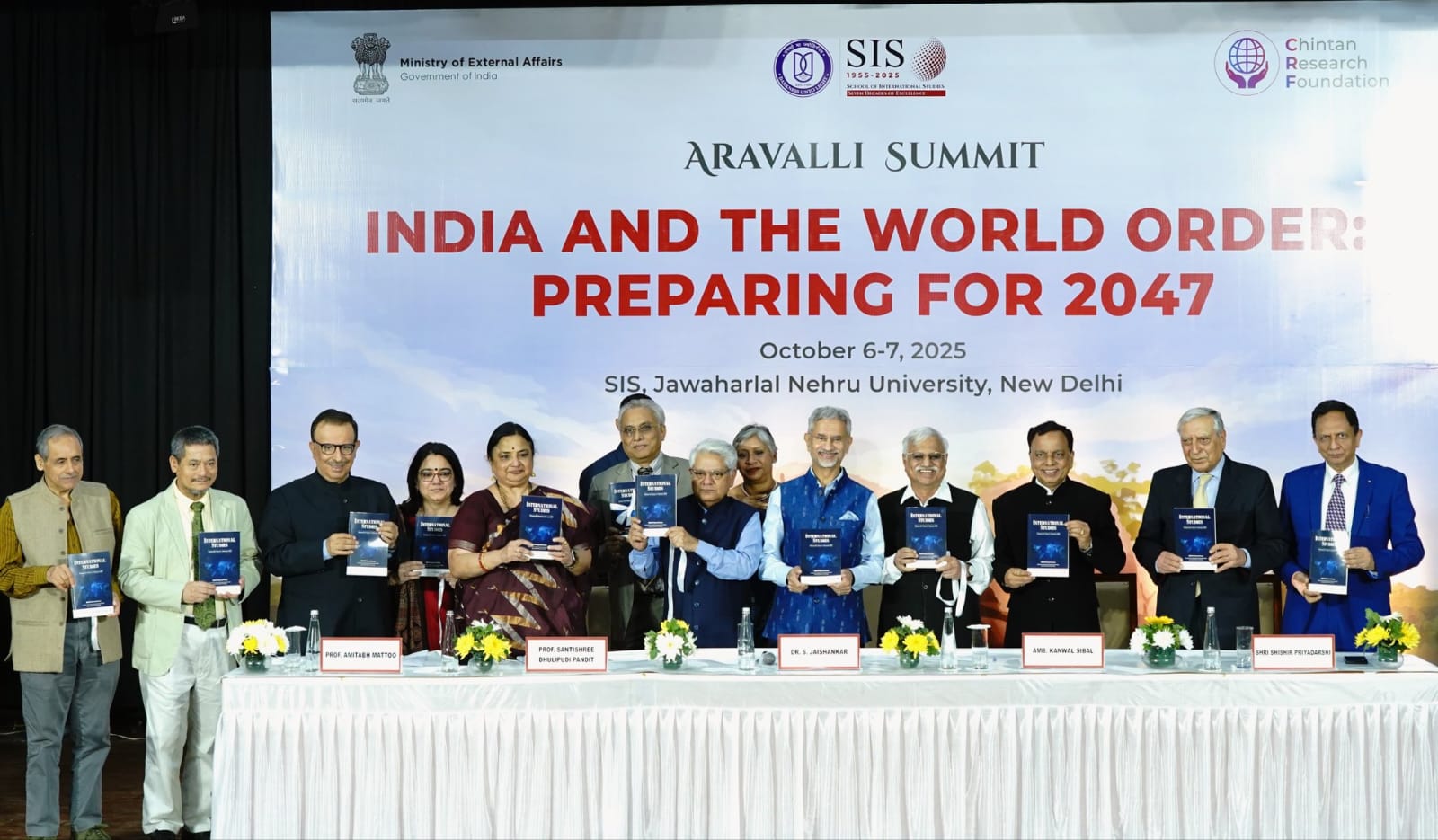
Delhi / The School of International Studies (SIS), Jawaharlal Nehru University, organized ithe second day of its flagship Aravalli Summit themed “India and the World Order: Preparing for 2047” on 7th October 2025. The event, held in collaboration with the Ministry of External Affairs and the Chintan Research Foundation on forms a part of the institution’s seventieth anniversary celebrations (SIS@70) that commemorates its long-held legacy in shaping India’s independent and influential voice in international affairs.
This conference sought to generate a high-level intellectual and policy-oriented dialogue on India’s journey toward 2047 and its ramifications for the evolving world order. It has combined the ‘inside-out’ perspective of Indian thought leaders with the ‘outside-in’ reflections of distinguished international scholars. Over the two days of deliberation, the aim has been to stimulate a forward-looking discourse on how India can shape – and be shaped by – the contours of a just, resilient, and inclusive global future.
The second day started with a working session on “Reimagining the Global Order: the Indian Imperative” featuring a distinguished panel comprising of Jorge Heine, former Ambassador to India and former minister of National Assets, Chile, Seong-ho Sheen, Professor and Dean, GSIS, Seoul National University, and Sanjay Kumar Verma, former Ambassador and Chairperson of RIS. The discussion led by Prof Ummu Salma Bava, Chairperson, Centre for European Studies, SIS, centred around India’s vision of being a rule maker in the current “global disorder”. Jorge Heine highlighted the breakup of the west as a geopolitical entity and the shift of global economic dynamism from the North Atlantic to Asia, while SNU Professor Seong Ho Sheen called for a shift in policy towards “strategic alignment.”
A Distinguished Address titled “Zero and beyond: India’s Scientific Imprint on the Globe” by Prof. Manjul Bhargava, Professor of Mathematics at Princeton University and adviser on Education to Government of India, followed next. A Fields Medalist, Bhargava threw light on ancient Indian contributions, particularly focusing on India’s “zero” and “non zero” contributions to mathematics, ranging from the Indian Numeral System, Baudhayana’s influence on the Pythagoras Theorem to Virahanka’s influence on the Fibonacci sequence and determination of the first exact formula of Pi. The audience was left enthralled by the demonstration of different patterns of the Chautisa Yantra.
The second working session “India’s Economic Ascent: Implications for the World” focused on the question of India’s ambition to become a $35 trillion economy by 2047 and if it is possible to achieve it through inclusive and sustainable growth. The panel featuring Sanjeev Sanyal, Member, EAC-PM, Prabir De, Professor, RIS, and Amita Batra, Professor, Centre for South Asian Studies, SIS, JNU was chaired by V. Anantha Nageswaran, Chief Economic Adviser, Government of India. Sanyal asserts that India “will do what is reasonable for our interests, will stand up for them, and will make reasonable trade-offs so long as the net benefit should be clearly positive”. Prof Batra, stating that India “punched really hard” at the WTO to make its position clear, also underlines an important proposition of enhancing our manufacturing sector capabilities as a necessity to exploit India’s demographic dividend.
Working Session 3, titled “India at the Frontiers of Technology and Innovation” discusses how India’s breakthroughs in medicine, software, space, and automation can optimally support its own development as well as its global technological status. Chaired by Professor Amit Shovon Ray, Centre for the Study of the World Economy, SIS, JNU, the panel feautue of Anirudh Sharma, founder and CEO, Digantara, Kiran Karnik, Chairperson, HelpAge India, and Santanu Chaudhury, Professor, Department of Electrical Engineering, IIT Delhi. The session analyzed India’s technological strategy within the context of the Fourth Industrial Revolution, framing technological supremacy as a transient, non-permanent asset fundamental to contemporary geo-economic and geopolitical competition. The panelists converged on the necessity of a decisive, forward-looking policy pivot to secure India’s status as Viksit Bharat by 2047 and called for “divergent thinking backed by congruent action.”
The fourth session, themed “India’s Global Footprint: Mobility, Migration and Diaspora” focused on the Indian diaspora that, through historical and contemporary movements, has contributed to global economies, cultures and diplomacy. The panel led by J.M. Moosa, Chairperson, Centre for African Studies, SIS featured Maurits S. Hassankhan, Professor of History, Anton De Kom University, Suriname, Ayodeji Olukoju, Distinguished Professor of History, University of Lagos, and Lomarsh Roopnarine, Professor of Caribbean & Latin American History, Jackson State University, USA. They examined if India’s transnational presence strengthen India’s soft power and facilitate in enduring people-to-people ties worldwide. Overall, the session affirmed that India’s global footprint is multifaceted, forged over centuries through the continuous movement of its people, encompassing indentured migration, the diaspora of skilled professionals, and the significant contemporary influence of its business enterprises. The diaspora’s economic contributions and growing political clout in host countries, alongside India’s soft power—channeled through its rich culture and foreign policy emphasizing Global South leadership—are actively shaping international economic and geopolitical dynamics. The discussion ended with acknowledging both the positive model of growth and the challenging questions regarding the ethical conduct and long-term implications of its expatriate business expansion.
India’s identity, rooted in a pluralistic heritage based on values of harmony, seeks to shape a new global consciousness. Following this line, the fifth working session, themed “India as a Civilisational State: Shaping a New Global Consciousness” focused on the whats and whys of India’s ancient history, as well as the hows of translating this rich heritage into an influential stream of soft power. The panel was chaired by Heeraman Tiwari, Chairperson, Centre for Historical Studies, School of Social Sciences, JNU and featured Anand Ranganathan, Professor, Special Centre for Molecular Medicine, JNU, J. Sai Deepak (Lawyer, Supreme Court and Author and Awadhesh Kumar Sharma, former Professor, Bhagalpur University. Ranganathan challenges narrow identities, asking, “When did I as an Indian national stop thinking that I was an Ethiopian?”. He concludes, “Civilization is correcting the historical wrongs that were meted out to your ancestors,” a principle he extends to injustices worldwide. He finishes by wishing that people would also “worship the Origin of Species”. Sai Deepak argues that while India (Bharat) aspires to shape global consciousness, it is currently embroiled in what he calls a “metaphysical civil war”. He contends this is not a battle of politics or ideologies, but fundamentally a “battle of metaphysics”. Because of this deep internal conflict, he believes that at this moment, India is projecting “not consciousness, but confusion”. Asserting that civilization is “downstream of metaphysics,” he states India must first resolve this internal struggle—a clash between monotheism and its native pantheistic traditions—before it can project a clear consciousness to the world.
The sixth working session looked at India’s climate diplomacy and how it is influenced by its rich traditions in ecological harmony. It focused on themes of climate finance, global climate negotiations, trade and climate, mitigation and adaptation strategies to climate change, internal and international climate justice, sustainability, clean energy transition and a green global agenda. The panel featured Manjeev Singh Puri, former Ambassador and Distinguished Fellow, Earth Science and Climate Change, TERI; Ulka Kelkar, Executive Program Director, Climate, Economics and Finance, WRI India; and Aparna Sawhney Professor, Centre for the Study of the World Economy, and was chaired by Debajit Palit, Centre Head, Chintan Research Foundation. As India aims to achieve its climate goals, the panel stressed that championing for climate justice globally should go hand in hand with climate justice within for a sustainable future. The session ended with the assertion that “climate change is definitely not a hoax, it’s real.”
The concluding and the valedictory session came back to the question of the kind of Global Power that India will be. Chairing the session, Vice-Chancellor of JNU Santishree Dhulipudi Pandit was joined by a panel that featured the Chancellor, JNU Kanwal Sibal, Malini Parthasarathy, Honorary Professor at SIS, JNU, and J. Nanda Kumar, All India Convener of ‘Prajna Pravaha’ Movement. India’s envisioned transition is not simply a bid to “join the ranks” of the developed countries in measurable terms but to bring a qualitatively new flavour to global governance as a responsible power. The panel discussed the characteristics that India should seek to inculcate and nurture in preparing for its new role in the international order.